
Local customers rarely move in a straight line. One person may find your business on Google Maps, skim your reviews, click to your website, compare your services, check your Facebook page, and then call. If any part of that path looks outdated, confusing, or inactive, the call may never happen.
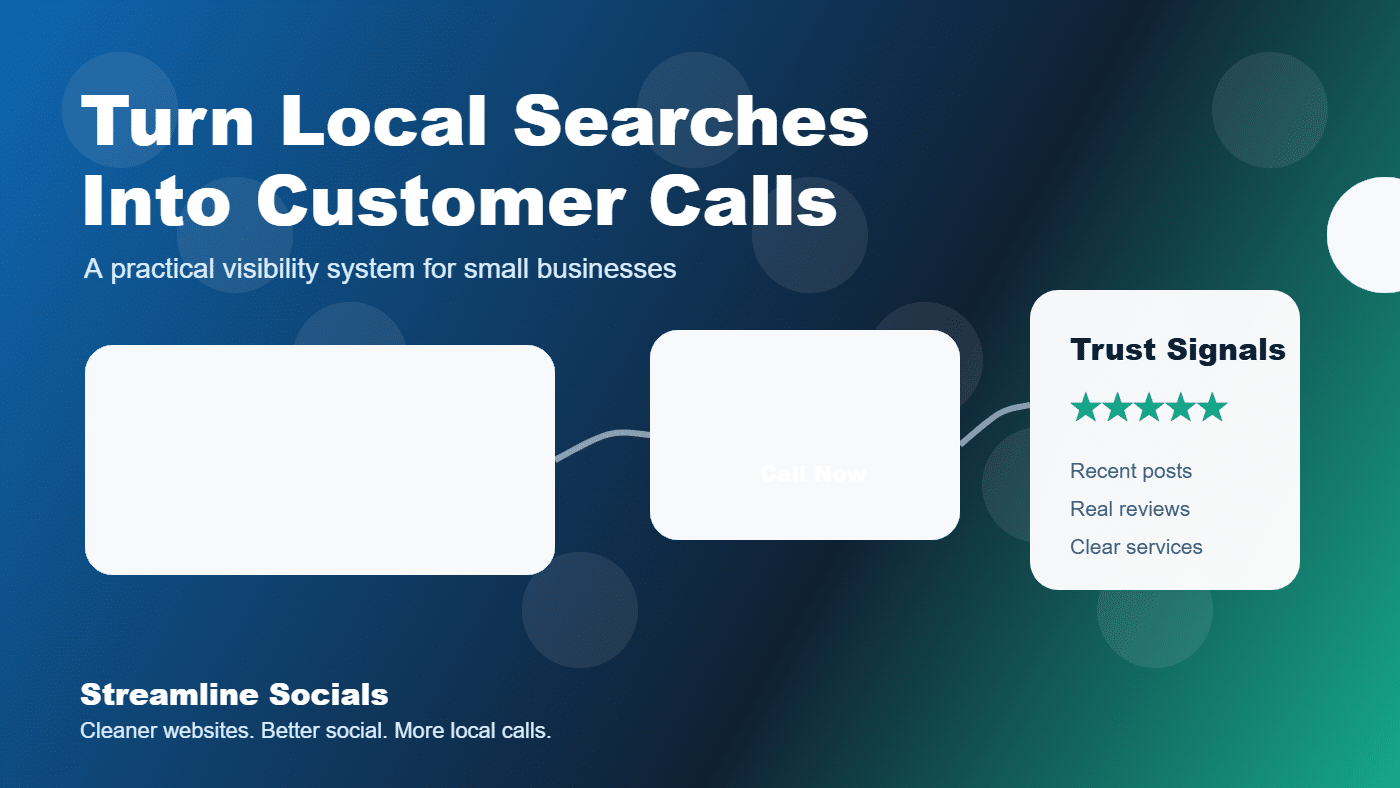
That is why local visibility is no longer just an SEO project. For small businesses, it is a connected system made up of your Google Business Profile, website, reviews, social media, and contact experience. When those pieces work together, you make it easier for nearby customers to trust you and take action.
Why local search matters more than ever
Google explains that local results are mainly shaped by relevance, distance, and prominence. In plain English, Google is trying to understand three things:
- Relevance: Does this business clearly match what the customer searched for?
- Distance: Is this business close enough to be useful?
- Prominence: Does this business appear credible, active, and trusted?
You cannot control every ranking signal, but you can control how complete, consistent, and helpful your online presence looks. That matters because customers are making quick decisions before they ever contact you.
Start with accurate business information
The foundation is simple: your business name, phone number, website, service area, hours, and categories need to be accurate everywhere customers find you. Google specifically recommends keeping Business Profile information complete and up to date because it helps customers understand what you do, where you are, and when they can reach you.
For many small businesses, the phone number is the conversion point. If your number is hard to find, inconsistent, or buried at the bottom of the page, you are making the customer work too hard. Your website should make calling, emailing, or submitting a form obvious from the homepage, service pages, and contact page.
Build service pages around real customer questions
A strong local website does not just say “we offer services.” It answers the questions a buyer is already asking:
- What exactly do you do?
- Who is this service for?
- What does it cost or what affects the price?
- What area do you serve?
- What happens after I contact you?
This is where small businesses often lose leads. A customer may be ready to call, but if the service page feels vague, outdated, or generic, they leave to compare another provider. Clear service pages help both search engines and people understand why your business is a good match.
Use reviews as proof, not decoration
Reviews are one of the strongest trust signals a local business can earn. They support prominence, help customers compare options, and give your marketing language more credibility. But reviews should not only live on one platform.
Use review themes throughout your marketing. If customers often mention fast communication, friendly service, clean work, or reliable follow-through, those phrases should influence your website copy, social posts, and service descriptions. That keeps your messaging grounded in what real customers already value.
Make social media support your search presence
Social media may not replace a website or Google Business Profile, but it does help customers answer an important question: “Is this business active?” An outdated social page can create doubt, even if your website is strong.
The goal is not to post randomly every day. The goal is to reinforce trust with a simple rhythm:
- Show recent work or behind-the-scenes activity.
- Explain common customer questions.
- Highlight reviews and customer outcomes.
- Share local updates, seasonal reminders, or timely offers.
- Point people back to the right website page or contact form.
That kind of content gives customers confidence that your business is reachable, organized, and still paying attention.
Create helpful content before customers are ready to buy
Google’s guidance on helpful, reliable, people-first content is a useful reminder: content should be created for people first, not just search engines. For local businesses, that means publishing articles, checklists, and service explanations that help customers make better decisions.
Examples include:
- “How to know when your website needs a refresh”
- “What to include on a small business homepage”
- “How often should a local business post on social media?”
- “What customers look for before calling a service business”
This type of content gives you more ways to be found, more material to share on social media, and more proof that your business knows what it is doing.
Turn visibility into action
Visibility alone is not the finish line. The real goal is action: a call, form submission, consultation request, quote request, booking, or visit. Every important page should make the next step clear.
A simple local conversion checklist:
- Put your phone number in visible places.
- Use one clear primary call-to-action.
- Keep forms short and functional.
- Link service pages to the contact page.
- Make sure your site works well on mobile.
- Use reviews, photos, and recent content to build trust before the ask.
The connected local visibility system
The businesses that win local attention usually do the basics consistently. Their Google profile is accurate. Their website explains services clearly. Their reviews support their claims. Their social media looks active. Their contact path is easy. None of those pieces has to be complicated, but they do need to work together.
If your online presence feels scattered, start with the customer journey. Search for your business the way a customer would. Click through your profile, website, reviews, service pages, and social accounts. Then ask one question: “Would this make me confident enough to call?”
Streamline Socials helps small businesses clean up that full journey — from website pages and calls-to-action to social content, blog strategy, and local visibility. If your marketing feels disconnected, a clearer system can turn more searches into real conversations.